
Quick Summary
A strong real money Mines casino game cash out strategy is not about guessing secret patterns; it is about controlling volatility, choosing a realistic mine count, setting a cash out target before the round starts, and protecting your bankroll from fast losses. Mines is simple to play, but the cash out decision makes it one of the most psychologically demanding instant win casino games in 2026.
- Best for cautious players: low mine count, small multiplier target, fast collection.
- Best for high-risk players: high mine count, one-click or two-click cash out plans.
- Most important rule: decide your exit before your first click.
- No tile pattern, corner method, or heatmap can overcome the house edge.
- Provably fair verification is valuable because it confirms the round was generated fairly.
Overview: What Makes Mines Different?
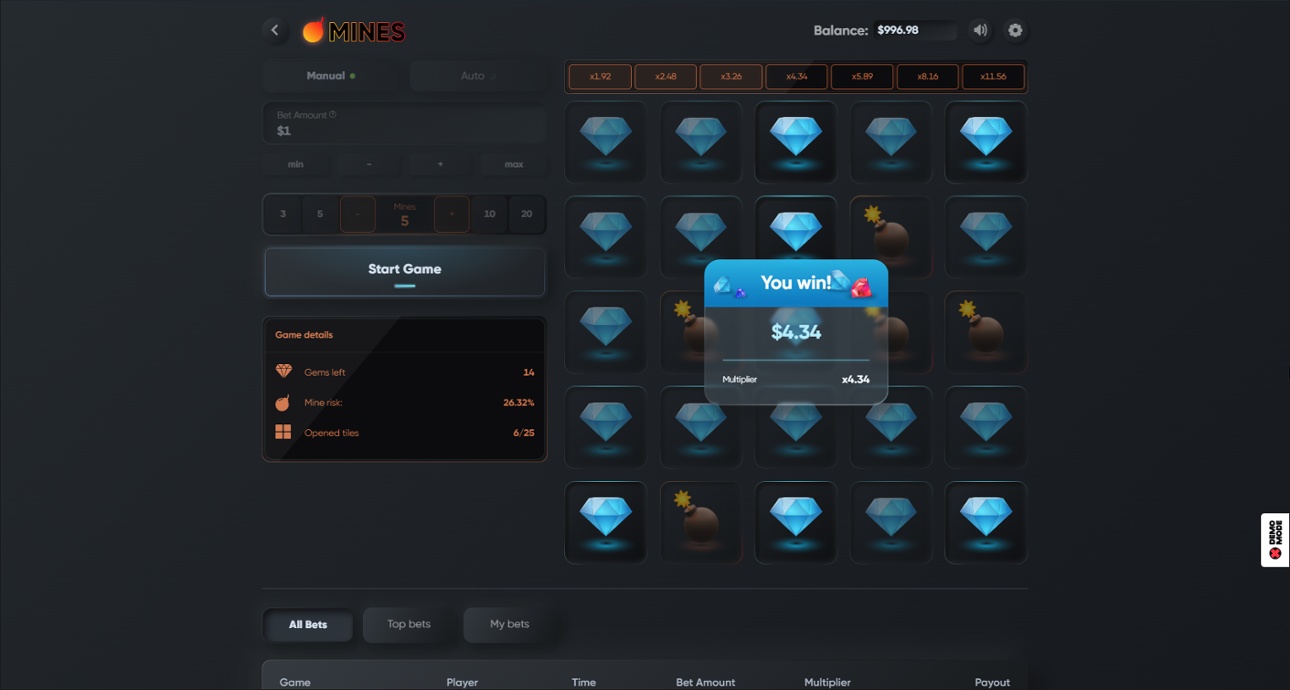
Mines is an instant win casino game inspired by the logic of Minesweeper. A typical board contains 25 tiles arranged in a 5×5 grid. Before each round, you choose your stake and the number of hidden mines. Safe tiles reveal gems, stars, diamonds, or similar symbols, while a mine ends the round and removes your stake. The more safe tiles you reveal, the higher your multiplier becomes.
The appeal of a real money Mines casino game cash out strategy is that the player controls when to stop. In many slot games, the spin result is complete the moment you press the button. In Mines, every safe click creates a new decision: collect now or risk one more tile. This interactive structure makes the game feel more strategic, even though the underlying tile placement remains random.
The best players understand that the goal is not to predict where mines are. The goal is to design a repeatable decision system that fits your bankroll, your risk tolerance, and your session length. A disciplined real money Mines casino game cash out strategy turns an emotional game into a structured bankroll exercise.
| Key Facts | |
|---|---|
| Game Type | Instant win grid game with manual or automatic cash out |
| Typical Grid | 25 tiles, usually 5×5 |
| Mine Range | Often 1 to 24 mines, depending on the provider |
| Common RTP Range | Usually around 96% to 99%, depending on rules and casino settings |
| Volatility | Player controlled through mine count and cash out timing |
| Main Skill | Risk management, not tile prediction |
| Best Safety Tool | Pre-set profit target, stop loss, and auto cash out |
| Core Warning | No real money Mines casino game cash out strategy can guarantee profit |
How to Play Mines for Real Money
Step 1: Choose Your Stake
Start by selecting a bet size that is small compared with your total bankroll. A practical rule is to risk no more than 1% of your session balance on a single round. If your session bankroll is $100, a $1 round is already enough to experience the game without exposing yourself to one bad sequence. This is especially important because Mines can move very quickly, and a poor real money Mines casino game cash out strategy can drain funds in minutes.
Step 2: Select the Number of Mines
The mine count determines the risk profile. One to three mines create a lower-volatility setup with frequent small wins. Eight to twelve mines create a more balanced setup where each click carries meaningful danger. Twenty or more mines create a high-volatility setup where one correct click can pay a strong multiplier, but most rounds will fail quickly.
Your real money Mines casino game cash out strategy should begin with the mine count, not with a random tile pattern. If you want steady, low-stress play, choose fewer mines. If you want rare but larger hits, choose more mines. The board does not owe you a safe tile just because you lost the previous round.
Step 3: Click Safe Tiles and Watch the Multiplier
Every successful click increases the multiplier. However, the increase is not free value. It is compensation for taking additional risk. With each safe tile removed, fewer safe tiles remain on the board. That means the next click becomes more dangerous. A smart real money Mines casino game cash out strategy treats each extra click as a new bet, not as a harmless continuation.
Step 4: Cash Out Before Emotion Takes Over
The cash out button is the heart of the game. New players often collect too late because they believe a winning round is proof of momentum. Experienced players do the opposite: they define a target multiplier before the first click and leave when it appears. If your plan is to cash out at 1.35x, then 1.35x is the finish line, not an invitation to chase 2x.
Cash Out Strategy Models That Actually Make Sense
The Low-Volatility Collection Plan
This real money Mines casino game cash out strategy uses one to three mines and a small number of clicks. The target is often between 1.10x and 1.50x, depending on the provider’s payout table. It suits players who prefer a higher hit frequency and are comfortable accepting modest profits. The downside is that one loss can erase several small wins, so stake control is essential.
A sample version is: choose two mines, click two or three tiles, then cash out every time. Do not extend the round just because the first few attempts worked. The power of this system is consistency, not excitement.
The Balanced Multiplier Plan
A balanced real money Mines casino game cash out strategy often uses four to seven mines and aims for two to four successful clicks. It creates a middle ground between tiny payouts and extreme risk. This approach can be suitable for players who want more meaningful multipliers without entering the brutal failure rate of very high mine counts.
The key is to reduce the stake compared with low-volatility play. If you are increasing risk through mine count, you should not also increase your bet size. One risk lever at a time is enough.
The High-Volatility Sniper Plan
The sniper version of a real money Mines casino game cash out strategy uses a high number of mines and aims to survive one click, sometimes two. With 20 or more mines on a 25-tile board, the chance of immediate failure is high, but the first safe tile can produce an attractive multiplier. This is not a steady-income method. It is a lottery-style approach within the Mines format.
If you use this plan, keep each stake very small and accept that losing streaks are normal. Do not double aggressively after losses. A long sequence of failed first clicks is not unusual in high-mine play.
Why Martingale Is Dangerous in Mines
Some players try to use a doubling system after every loss. This looks logical on paper, but it can collapse quickly because bet sizes grow faster than most bankrolls. A $1 loss becomes $2, then $4, then $8, then $16, then $32. After only a few failures, the required next bet becomes uncomfortable or impossible. A responsible real money Mines casino game cash out strategy avoids any system that requires unlimited funds.
Bonus Features and Tools That Help
Auto Cash Out
Auto cash out is one of the most useful features in Mines. It allows you to pre-set a multiplier or number of safe clicks so the game collects automatically when your target is reached. This supports a disciplined real money Mines casino game cash out strategy because it removes hesitation, greed, and last-second emotional decisions.
Auto Bet and Stop Conditions
Some versions include auto bet controls, stop on profit, stop on loss, and reset after win settings. These features can be helpful, but only if used conservatively. Automation should enforce your limits, not speed up reckless play. Before activating auto bet, test your real money Mines casino game cash out strategy in demo mode or with the smallest available stake.
Provably Fair Verification
Many modern Mines games use provably fair technology. This system typically combines a server seed, client seed, and nonce to create a verifiable result. After the round, you can check that the mine layout was generated fairly and was not changed after your clicks. Provably fair tools do not improve your odds, but they increase trust in the game’s randomness.
Mobile Play Features
Mines works especially well on mobile because each round is short and the interface is simple. However, mobile speed can also lead to impulsive betting. If you play on a phone, use session reminders, deposit limits, and a written real money Mines casino game cash out strategy before you begin.
RTP/Volatility: The Math Behind Cash Out Decisions
Understanding RTP
RTP, or return to player, is the long-term theoretical percentage returned to players over a very large number of rounds. If a Mines game has a 97% RTP, the casino edge is about 3% over time. This does not mean you will receive 97% of your money back in one session. Short-term results can be far above or below the theoretical average.
A real money Mines casino game cash out strategy cannot remove the house edge. What it can do is shape how you experience variance. Low mine counts create more frequent small outcomes. High mine counts create more dramatic swings. Both can have the same RTP while feeling completely different.
Probability Changes After Every Click
On a 25-tile board with three mines, your first click has 22 safe tiles out of 25, or an 88% chance of success. If you survive, the next click has 21 safe tiles out of 24. The chance remains high early, but it declines as more safe tiles are removed. The longer you continue, the more fragile your round becomes.
This is why the best real money Mines casino game cash out strategy focuses on stopping points. The multiplier rises because the risk rises. A bigger displayed number is not a gift; it is the price of continuing.
Volatility by Mine Count
With one mine, the game feels calm because most early clicks are safe. With twelve mines, every click feels tense. With twenty-four mines, there is only one safe tile on the board. Volatility is not hidden in Mines; you choose it before the round begins. That makes the game flexible but also risky for players who overestimate their tolerance for losing streaks.
Bankroll Rules for 2026 Players
Use three limits: a round limit, a stop-loss limit, and a profit lock. The round limit controls bet size. The stop-loss limit ends the session when losses reach a set amount. The profit lock protects winnings by ending the session or reducing stakes after a good run. A practical real money Mines casino game cash out strategy includes all three before any money is wagered.
Common Myths About Mines Cash Out Strategy
Myth: Corners Are Safer
Every tile has the same chance of being a mine at the start of a fair round. Corners, center tiles, edges, diagonals, and shapes are all cosmetic choices. You may use a pattern to stay consistent, but it does not create a mathematical edge.
Myth: A Mine Is Less Likely After Several Losses
Each round is independent. A losing streak does not force a win to appear. This belief is called the gambler’s fallacy, and it is one of the biggest threats to any real money Mines casino game cash out strategy.
Myth: Social Heatmaps Reveal Safe Tiles
Some casinos display social activity or recent outcomes. These features can be entertaining, but they should not guide real-money decisions. Other players’ boards do not change the probability of your board in a properly random game.
FAQ
Q: What is the best real money Mines casino game cash out strategy?
Q: Can a real money Mines casino game cash out strategy guarantee profit?
Q: Is it better to play with fewer mines or more mines?
Q: Should I use auto cash out in Mines?
Final Verdict
Mines is popular because it combines simple rules with high-pressure decision-making. The board is random, but your response does not have to be. A winning mindset begins with accepting that no pattern beats probability, no streak guarantees the next result, and no aggressive recovery system is safe forever.
The most reliable real money Mines casino game cash out strategy is built on small stakes, clear targets, strict stop losses, and honest respect for volatility. Treat every extra click as a new risk, use auto cash out when possible, and remember that the smartest cash out is often the one made before greed has time to argue.



One Comment
Editorial Review: This guide has been reviewed by the editorial team for clarity, practical value, mobile usability, payment safety, and safer decision-making.